The Illusion of Darkness

“Blessed are they that do his commandments, that they may have right to the tree of life, and may enter in through the gates into the city.”
– Revelation 22:14 (KJV)

Introduction

The dilemma of choosing between the allure of darkness and the lifelong commitment to walking in the light is a struggle we all encounter. Whether consciously or subconsciously, every decision we make leans us towards one or the other. The story of John and Mark illustrates this eternal struggle and shows us that the choices we make have profound implications on our spiritual well-being.

Devotional Story

John and Mark were lifelong friends, but each had chosen a different path. John reveled in worldly pleasures, seeking the next thrill without much thought about its impact on his soul. Mark, however, valued his spiritual journey and treaded carefully, guided by God’s word.

As time passed, John’s life began to unravel. His moments of pleasure left a hollow feeling in his soul, a spiritual emptiness that seemed to grow with every indulgence. Mark watched his friend’s deterioration with a heavy heart.

He approached John one day and shared the words of wisdom:

“For what shall it profit a man, if he shall gain the whole world, and lose his own soul?”
– Mark 8:36 (KJV)

This scripture hit John like a ton of bricks. He realized the cost of his choices and felt the weight of the emptiness within him. It was a difficult realization, but also a turning point.

Determined to change, John began his tough journey back to the light. With Mark’s support and the strength found in God’s word, he was able to break free from the shackles of his previous life. And as he did, he found himself not only spiritually rejuvenated but also a beacon of light for others lost in the darkness.

“The path of the just is as the shining light, that shineth more and more unto the perfect day.”
– Proverbs 4:18 (KJV)

Conclusion

The story of John and Mark serves as a stern reminder that the allure of darkness may seem rewarding in the short term, but ultimately leaves us spiritually bankrupt. Darkness can lift us, yes, but only up to a point. It gives us the illusion of elevation while placing a low ceiling above our heads. We may climb, but we never reach the heights we were destined for. Even worse, we become isolated, separating ourselves from the true Source of all LIGHT and TRUTH. True fulfillment and spiritual growth are only found in walking in the LIGHT, following God’s commandments, and being mindful of the impact of our choices.

In making these choices, we not only lift ourselves but also serve as beacons guiding others towards God, fulfilling our role as the salt and light of the Earth.

“Let us walk honestly, as in the day; not in rioting and drunkenness, not in chambering and wantonness, not in strife and envying.”
– Romans 13:13 (KJV)

Faith Notes

The verse from Romans 13:13 is a call to moral and ethical living, typically attributed to the Apostle Paul in the New Testament. The verse serves as a moral compass, urging people to adopt a lifestyle of integrity and righteousness.

“Walk honestly, as in the day”:

The metaphor of walking “in the day” suggests living openly and transparently, with nothing to hide. Daylight is often associated with visibility, truth, and goodness.

“Rioting and drunkenness”:

These terms refer to behaviors marked by excess and a lack of self-control, specifically regarding substance abuse and unruly behavior. They symbolize the abandonment of rationality and virtue.

“Chambering and wantonness”:

These archaic terms point toward sexual immorality and unrestrained indulgence in sensual pleasures. They serve as warnings against behaviors considered detrimental to spiritual growth.

“Strife and envying”:

These words refer to social and relational disharmony, resulting from selfishness or jealousy. They act as reminders to avoid toxic emotions that sow discord.

The verse implores us to live in a way that is harmonious with others and pleasing to God, emphasizing the importance of moral choices and their impact on our spiritual well-being. It invites us to shift our focus from worldly vices to a higher, spiritual calling.

May we continue to push back the darkness and illuminate the world with the Holy Light of our Eternal Creator.

“Trust in the LORD with all thine heart; and lean not unto thine own understanding. In all thy ways acknowledge him, and he shall direct thy paths.” (KJV)

Like in the illustration below, If we trust in the LORD with all our hearts and push back on our own flesh, push back on our own will, then God will collapse the darkness and His light will make our paths straight! Trust God, be the co-pilot, and let Him take control!


Seeds of Transformation

“Be not conformed to this world: but be ye transformed by the renewing of your mind.” (Romans 12:2, KJV)

 Introduction

Micah, a man striving to walk a godly path, found himself in a situation that tested his convictions. The story of a dream about a mansion filled with sin transforming into a garden of light intrigued him and prompted him to reflect deeply on his own life.

Devotional Story

Micah found himself at a grand gala, a space filled with wealth and partying. Though the atmosphere was one of celebration, he felt a disconcerting emptiness. He knew this was not the way, not the life God intended for him.

“Be not conformed to this world: but be ye transformed by the renewing of your mind.” (Romans 12:2, KJV)

Deciding not to engage in the sinful activities around him, Micah made his exit. On his way out, he noticed workers cleaning up—perhaps a symbolic sign for how life’s messes eventually must be confronted and managed.

Once outside, he discovered a tranquil garden. On an ancient stone table lay seeds with an inscription: “Water these seeds and watch them grow into light.” Filled with faith, Micah watered the seeds. They instantly sprouted into magnificent beings of light.

“Therefore if any man be in Christ, he is a new creature: old things are passed away; behold, all things are become new.” (2 Corinthians 5:17, KJV)

Conclusion

Micah’s journey serves as a metaphor for the struggles many of us face in modern life. The grand gala, with all its temptations, is symbolic of the broader world that often pulls us away from spiritual focus. Micah’s decision to leave this environment reflects the difficult but necessary choices we must make to align ourselves with a higher spiritual calling.

The seeds in the garden and their transformation into beings of light represent the latent potential within each of us. When we nurture our spiritual selves, we not only transform internally but also have a positive impact on the world around us. Micah’s experience mirrors the Biblical notion of ‘dying to the old self and being reborn in Christ.’

The story aims to reinforce several key Biblical principles, such as the importance of personal transformation (‘be ye transformed by the renewing of your mind’), the idea that actions speak louder than words (‘let your light so shine before men’).

The devotional is a call to action for each of us to examine where we are spiritually and how we can make meaningful changes to grow closer to God. It urges us not just to be hearers of the Word, but doers as well.

“Let your light so shine before men, that they may see your good works, and glorify your Father which is in heaven.” (Matthew 5:16, KJV)


The Mission Field Next Door

“Ye are the light of the world. A city that is set on a hill cannot be hid.” (Matthew 5:14, KJV)

Introduction:

We often hear incredible tales of missionaries who venture to far-flung places, spreading the Gospel in challenging environments. While these stories are inspirational, they sometimes lead us to believe that being a missionary requires us to leave our country or make dramatic life changes. Today, let’s explore the concept that the mission field can be closer to home—perhaps as close as our own neighborhood.

Devotional Story:

Meet Emily and Sarah, two devout friends. Emily had always felt a calling to be a missionary but was unable to travel abroad due to family responsibilities. Sarah, on the other hand, had recently returned from a mission trip to Africa. The contrast between their circumstances led Emily to question her ability to serve God effectively.

“I wish I could make as significant an impact as you, Sarah,” Emily lamented one day.

Sarah smiled, recalling the words of Jesus:

“For where two or three are gathered together in my name, there am I in the midst of them.” (Matthew 18:20, KJV)

“Emily,” Sarah responded, “You don’t have to go to another country to be a missionary. Your mission field is wherever God has placed you, even if it’s just in our neighborhood.”

Inspired by Sarah’s words, Emily started a Bible study group in her community, inviting her neighbors and sharing the Gospel with them. The group gradually grew, transforming lives one by one. Emily realized she was fulfilling her calling right where she was, embracing the Apostle Paul’s wisdom:

“And whatsoever ye do, do it heartily, as to the Lord, and not unto men.” (Colossians 3:23, KJV)

Conclusion:

The stories of Emily and Sarah serve as a reminder that we all have a mission field, whether it’s across the ocean or across the street. Both are valid and valuable in the eyes of God. The key is to serve where you are planted, using the gifts God has given you to reach those around you.

So if you find yourself unable to venture far, remember that you can still make a significant impact right where you are. The Apostle Peter’s words affirm this universal call to discipleship:

“As every man hath received the gift, even so minister the same one to another, as good stewards of the manifold grace of God.” (1 Peter 4:10, KJV)

Missionary work isn’t limited to foreign lands. Our very own community can be our mission field, calling us to illuminate the darkness and bring others closer to God.

“Let your light so shine before men, that they may see your good works, and glorify your Father which is in heaven.” (Matthew 5:16, KJV)

The Cultural Feast

“Behold, how good and how pleasant it is for brethren to dwell together in unity!” (Psalm 133:1, KJV)

Introduction:

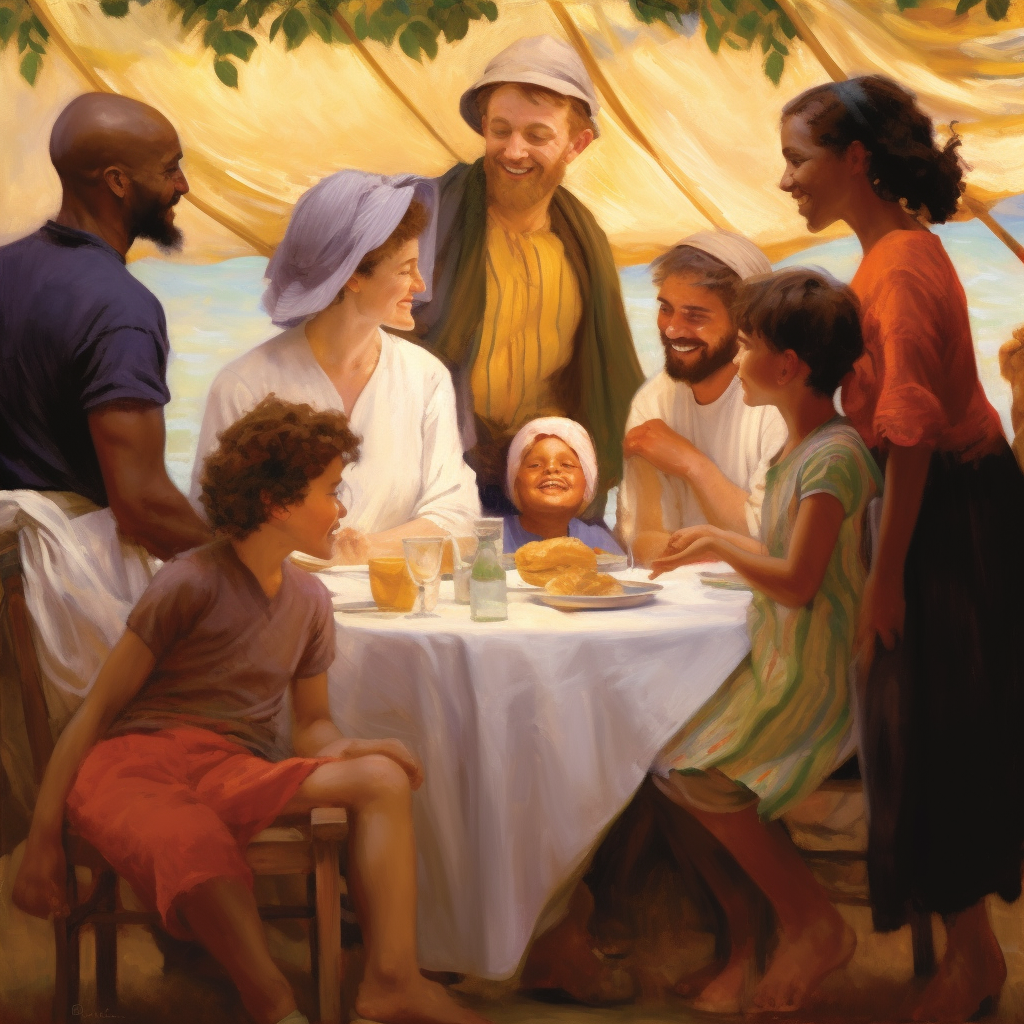
Today’s devotional introduces the parable of the Cultural Feast, where a diverse community gathers to celebrate but finds themselves divided. Amidst the fragmentation, one individual emerges to unify the divided crowd. This narrative prompts us to meditate on our own roles as agents of unity and reconciliation in a world often rife with division.

Devotional Story:

In a small, bustling town, a grand feast was organized to celebrate the cultural richness of the community. Everyone was invited—farmers and scholars, rich and poor, people of all ethnic backgrounds. However, as the feast began, an unintended divide occurred: People started clustering based on their culture, language, or social status.

Among the attendees was Samuel, who noticed the fragmentation. Unlike others, Samuel moved from one group to another, sharing laughter, stories, and breaking bread. His actions began to dissolve the invisible walls; people started crossing boundaries to share and celebrate together.

Samuel’s role emulates Christ, who came to earth to “break down the middle wall of partition between us” (Ephesians 2:14, KJV).

 13. But now in Christ Jesus you who once were far away have been brought near by the blood of Christ.
14. For he himself is our peace, who has made the two groups one and has destroyed the barrier, the dividing wall of hostility,
15. by setting aside in his flesh the law with its commands and regulations. His purpose was to create in himself one new humanity out of the two, thus making peace,   (Ephesians 2:13-15 KJV).

Just like Samuel, Christ mingled with people from all walks of life, bringing them into a unity that transcended earthly divisions. The atmosphere in the feast transformed, embodying the biblical truth:

“There is neither Jew nor Greek…for ye are all one in Christ Jesus” (Galatians 3:28, KJV).

Conclusion:

The Parable of the Cultural Feast compels us to examine our role in either perpetuating divisions or fostering unity. The character of Samuel stands as an example of what it means to live out Christ’s call for reconciliation and unity. The Apostle Paul succinctly encapsulates this in his letter to the Colossians:

“And above all these things put on charity, which is the bond of perfectness” (Colossians 3:14, KJV).

Our role is not just to fit into a specific group but to act as connectors, uniting disparate parts into a harmonious whole. By doing so, we mirror the divine love and unity that God intends for all His children.

“But grow in grace, and in the knowledge of our Lord and Saviour Jesus Christ. To him be glory both now and for ever. Amen.” (2 Peter 3:18, KJV)

The Tale of Two Orchards

“Each one should test their own actions. Then they can take pride in themselves alone, without comparing themselves to someone else.” (Galatians 6:4, KJV)

Introduction:

In today’s devotional, we explore a narrative centered on two neighbors, Alice and Thomas, who find themselves stewards of two very different orchards. This story illuminates the eternal principles of compassion for others and responsibility toward oneself, drawing us into deep contemplation on how to balance these essential virtues.

Devotional Story:

Alice and Thomas were neighbors, each possessing a beautiful orchard. Alice’s orchard was flourishing with ripe fruits, while Thomas’s was visibly struggling, its trees barren and leaves wilting. When Alice learned of a nearby public orchard that was in poor condition, her heart filled with compassion.

“I feel we ought to take care of that public orchard,” Alice said to Thomas one morning.

Together, they dedicated time and effort into reviving the struggling public orchard. The local children cheered as the trees started bearing fruit again. An elderly man, Mr. Wilson, who often visited the orchard, gratefully said, “God bless you, for you have given life to this dying place,” echoing the Bible’s counsel:

“Whoever is kind to the poor lends to the Lord, and he will reward them for what they have done.” (Proverbs 19:17, KJV)

However, as days passed, Thomas couldn’t shake off the thought of his own failing orchard. He decided to speak his mind. “Alice, it’s wonderful what we’ve done for the community. But shouldn’t we also take care of our own orchards?”

Alice paused, contemplating Thomas’s words and the wisdom they carried:

“He that is faithful in that which is least is faithful also in much.” (Luke 16:10, KJV)

Conclusion:

The parable of Alice and Thomas gives us a window into the dual obligations of Christian life—responsibility to oneself and compassion toward others. This story touches upon the Biblical principles echoed in the New Testament, specifically the letters of Paul, that teach us to fulfill our own duties,

“But let every man prove his own work, and then shall he have rejoicing in himself alone, and not in another.” (Galatians 6:4)

while also being kind to others.


“Therefore, as we have opportunity, let us do good to all people, especially to those who belong to the family of believers.” (Galatians 6:10)

The public orchard, symbolizing the wider community or even ‘the world,’ benefited from Alice and Thomas’s selfless giving. It brings to mind Proverbs 19:17:

He that hath pity upon the poor lendeth unto the Lord; and that which he hath given will he pay him again.” (Proverbs 19:17)

Compassion is not just a social virtue; it’s a spiritual mandate.

However, the story doesn’t end there. Thomas’s own struggling orchard serves as a crucial counterpoint, illustrating the Biblical lesson of personal responsibility. According to 1 Timothy 5:8,

“But if any provide not for his own, and specially for those of his own house, he hath denied the faith, and is worse than an infidel.” ( 1 Timothy 5:8)

In essence, while God calls us to love and serve others, He also calls us to manage our own lives responsibly. It’s not an either/or situation; it’s a balanced and harmonious both/and scenario. This balance is what the Apostle Paul implores us to seek in Galatians 6:10.

So as you go about your daily life, may you find inspiration in this tale of two orchards. Let it remind you that in fulfilling your duties toward others and yourself, you are walking the path that God has laid out for you, nurturing both the public orchards and the personal ones in your life.

“But grow in grace, and in the knowledge of our Lord and Saviour Jesus Christ. To him be glory both now and for ever. Amen.” (2 Peter 3:18,)

The Power of Reputation: A Lesson in Character and Community

“A good name is rather to be chosen than great riches, and loving favour rather than silver and gold.” (Proverbs 22:1, KJV)

 Introduction

James found himself standing next to the office water cooler, listening intently as colleagues discussed the big announcement. A coveted spot in the Golden Wing, the company’s elite division, was open. No one knew who might fill it, and the tension was palpable. Anna, a wise and thoughtful coworker, sensed the anticipation in the air and felt moved to share her thoughts.

Devotional Story

The rumor mill churned with names, guesses, and secret hopes, painting the atmosphere with a mix of excitement and dread. James leaned against the counter, sipping his coffee, intrigued by the office dynamics. “Who do you think will get the spot?” he asked, more to the room than to anyone in particular.

Anna, overhearing the speculation, seized the moment to bring wisdom into the discussion. “You know, it’s not just about the skill set or experience. A good reputation goes a long way in influencing decisions.”

As if on cue, their manager walked in and said, “I’m pleased to announce that Caleb will be joining the Golden Wing.”

The room erupted in spontaneous applause and cheers, even though most had never met Caleb. They only knew of his excellent reputation—his dedication, his wisdom, and his high ethical standards. Anna leaned towards James and quoted:

“Even a child is known by his doings, whether his work be pure, and whether it be right.” (Proverbs 20:11, KJV)

James looked at Anna with newfound respect. “You’re right; reputation really does precede us.”

Anna nodded, her eyes shining with wisdom. “Yes, and remember, the Bible teaches us that a good name is a precious thing, influencing not just our fate but the well-being of the community around us.”

Conclusion

The story of Caleb’s promotion and the community’s joyous reaction offers a timeless message about the value of a good reputation and the positive impact it can have on a community. It’s easy to get caught up in the competition and self-interests, forgetting that our actions influence not just our own lives, but also the spirit and ethos of those around us.

“Let your light so shine before men, that they may see your good works, and glorify your Father which is in heaven.” (Matthew 5:16, KJV)

Much like James came to realize, reputation isn’t a personal commodity; it’s a communal treasure. Caleb’s story reminds us that while skills and achievements can certainly move us forward, it’s our character that leaves a lasting impression. The Bible encourages us to live in such a way that we’re not just seeking our own advancement, but are also contributing to the well-being and morale of the community we are part of.

“Look not every man on his own things, but every man also on the things of others.” (Philippians 2:4, KJV)

In our quest for personal success, let’s not forget the Biblical wisdom that teaches us to also consider how we can positively impact those around us, thereby glorifying God.


“And whatsoever ye do, do it heartily, as to the Lord, and not unto men; Knowing that of the Lord ye shall receive the reward of the inheritance: for ye serve the Lord Christ.” (Colossians 3:23-24, KJV)

Finding Peace in Troubling Times: A Waiting Room Revelation

“Be not anxious for your life, what ye shall eat, or what ye shall drink; nor yet for your body, what ye shall put on. Is not the life more than the food, and the body than the raiment?” (Matthew 6:25, KJV)

Introduction

Peter found himself in a doctor’s office waiting room. The news playing on the TV caught his attention, filling him with concern. Sitting a few seats away, Mary, a woman with kind eyes, sensed his unease and felt moved to speak.

Devotional Story

The news anchor reported on various crises: wildfires ravaging communities, political conflicts unsettling nations, and poverty rates skyrocketing. It felt like the world was crumbling. Peter shook his head and muttered, “This world’s just falling apart, isn’t it?”

Mary, hearing the despair in Peter’s voice, saw an opportunity to share wisdom from her faith. “I can’t help but notice you’re bothered by the news. Jesus has a way of comforting us when the world feels overwhelming. He said,

‘Be not anxious for your life, what ye shall eat, or what ye shall drink; nor yet for your body, what ye shall put on. Is not the life more than the food, and the body than the raiment?'” (Matthew 6:25, KJV)

Peter’s eyes met Mary’s. “That’s from the Bible? You think that can really help with all that’s going on?”
Mary nodded, her face earnest. “Yes, I do. In times like this, Jesus also offers us another promise:

‘Come unto me, all ye that labor and are heavy laden, and I will give you rest.'” (Matthew 11:28, KJV)

For a moment, the noisy waiting room seemed to fade away. Peter felt as though a weight had been lifted off his shoulders. Mary’s words, filled with scripture, resonated with him, offering a sliver of hope amidst chaos. Peter finally heard his name called for his appointment. As he stood up, he felt different. The world’s problems hadn’t changed, but his perspective had. He felt fortified by Mary’s words, uplifted by the wisdom and assurance that he was not alone in facing life’s challenges.

Conclusion

The story of Peter and Mary in the waiting room offers more than just a narrative. It delivers a timeless message of comfort grounded in biblical truths. In a world increasingly fraught with crises and hardships, it’s easy to succumb to worry and despair. Yet, the Bible repeatedly reassures us that our anxieties, our burdens, and even our worldly troubles are not ours to bear alone.

“Cast thy burden upon the LORD, and he shall sustain thee: he shall never suffer the righteous to be moved.” (Psalm 55:22, KJV)

It’s a profound notion: the idea that the omnipotent God invites us to cast our anxieties onto Him. Yet, how often do we forget this in the hustle and bustle of daily life, especially when the world’s woes seem magnified by 24/7 news cycles? Peter’s initial reaction to the news is one many of us can relate to—feeling overwhelmed, even despairing, at the state of the world.

Yet, as Mary reminds Peter, we have the assurance that when all seems lost, God remains a source of steadfastness and peace. The Bible not only encourages us to turn our gaze toward Him, but it also assures us that things will fall into place, even if it doesn’t seem like it at the time.

“And we know that all things work together for good to them that love God, to them who are the called according to his purpose.” (Romans 8:28, KJV)

In moments of difficulty, we are encouraged to surrender our worries to God and trust in His providence. Sometimes, a simple shift in perspective is all it takes to see our circumstances in a new light, just as Peter did after speaking with Mary.

“Trust in the LORD with all thine heart; and lean not unto thine own understanding. In all thy ways acknowledge him, and he shall direct thy paths.” (Proverbs 3:5-6, KJV)

In times of turbulence and uncertainty, let us remember that the peace of God “which passeth all understanding, shall keep your hearts and minds through Christ Jesus” (Philippians 4:7, KJV). God’s word promises us that when we are burdened, we can find rest and peace in Him. This doesn’t mean that all of life’s problems will magically disappear, but it does offer the profound comfort that we are not alone in facing them.

6 Be careful for nothing; but in every thing by prayer and supplication with thanksgiving let your requests be made known unto God. 7 And the peace of God, which passeth all understanding, shall keep your hearts and minds through Christ Jesus. (Philippians 4:6-7, KJV)

The Unseen Warmth

“Greater love hath no man than this, that a man lay down his life for his friends.” (John 15:13, KJV)

Introduction

Nancy, a devout believer, had lately found herself in a spiritual rut. She wondered what it truly meant to love others the way Jesus does. Then, she heard the story of Farmer John and a helpless baby horse, told by the farm workers who witnessed it. The story changed her perception of what love really means.

Devotional Story

On a bitterly cold winter morning, Farmer John discovered a baby horse stuck in a frozen pond. His farm workers and some folks who were just passing by watched as he quickly removed his warm jacket and shirt without a second thought. Shivering in the icy wind, he waded into the pond and lifted the struggling animal into his arms.

“Greater love hath no man than this, that a man lay down his life for his friends.” (John 15:13, KJV)

Witnessing this, the onlookers and farm workers couldn’t help but be moved. Nancy, hearing the account later, felt her heart swell with admiration for John’s selfless act.
As John made his way back to the shore, his body quaking from the cold, he wrapped his discarded clothing around the shivering foal. The workers hurriedly brought blankets and joined in to help warm the animal.

“My little children, let us not love in word, neither in tongue; but in deed and in truth.” (1 John 3:18, KJV)

Nancy felt like the message was loud and clear. True love wasn’t just words or good intentions; it was actions, even if those actions meant personal discomfort or risk.

Conclusion

Nancy’s spirit was lifted that day. The story was more than just heartwarming; it served as a vivid example of the depth of love Christ calls each of us to have for others. The farm workers and those who witnessed John’s act couldn’t forget what they saw; neither could Nancy. It urged her to examine her own life and how she could manifest this kind of love to others.

“And let us not be weary in well doing: for in due season we shall reap, if we faint not.” (Galatians 6:9, KJV)

This lesson, witnessed by ordinary folks and shared with Nancy, affirmed that true love often requires us to go beyond our comfort zones. It challenged her to be more Christ-like, to be a person who loves not just in words, but in meaningful action.

And Jesus called the people unto him, and said, “Here’s a tale that happened not so long ago.”

And He began, “True love involves sacrifice, for to love is to serve.”

“Therefore, anyone who humbles himself to help another shows the love I teach.”

“And he that does good unto even the least of these, does it unto me.” (Matthew 25:40)

The Butterfly’s Whisper

1. At the same time came the disciples unto Jesus, saying, Who is the greatest in the kingdom of heaven?

2. And Jesus called a little child unto him, and set him in the midst of them,

3. And said, Verily I say unto you, Except ye be converted, and become as little children, ye shall not enter into the kingdom of heaven.

4. Whosoever therefore shall humble himself as this little child, the same is greatest in the kingdom of heaven.

5. And whoso shall receive one such little child in my name receiveth me. (Matthew 18:1-5)

Introduction

Rebecca, though sincere in her devotion to God, had felt her enthusiasm wane amidst the busyness of adult life. A chance encounter with a butterfly, and young Luke’s childlike joy in the experience, served as a vivid reminder of the awe and wonder that should characterize her faith.

Devotional Story

Rebecca was diligently reading her Bible in the garden when she heard an excited voice. It was Luke, her young neighbor, enchanted by a butterfly fluttering about.

“Look, Miss Rebecca, a butterfly! Do you think God paints each one by hand?”

“The heavens declare the glory of God; and the firmament sheweth his handywork” (Psalm 19:1, KJV).

Caught off guard, Rebecca pondered the simple yet profound question. She had indeed lost that childlike sense of wonder.

Luke’s eyes followed the butterfly as it danced in the air. “Isn’t it amazing how it starts as a caterpillar and becomes something so beautiful? That’s like us when we find God, right?”

“Therefore if any man be in Christ, he is a new creature: old things are passed away; behold, all things are become new” (2 Corinthians 5:17, KJV).

Rebecca felt her heart stir. Luke had captured the essence of transformation in Christ, something she had started to take for granted.

Finally, the butterfly settled on a flower, its delicate wings closing in prayer-like fashion. “I bet the butterfly is thanking God for the flower,” Luke mused.

“In every thing give thanks: for this is the will of God in Christ Jesus concerning you” (1 Thessalonians 5:18, KJV).

Conclusion

That day, Rebecca’s heart was touched and humbled by Luke’s observations. His childlike awe and wonder were a strong reminder of the attitude she should maintain in her walk with God.

“Let us not be weary in well doing: for in due season we shall reap, if we faint not” (Galatians 6:9, KJV).

Luke’s excitement served as an inspiration for Rebecca to reinvigorate her own relationship with God, reminding her that a deep sense of wonder and awe is essential in our journey of faith.

“Except ye be converted, and become as little children, ye shall not enter into the kingdom of heaven” (Matthew 18:3, KJV).

The Orange Kickball: A Lesson in Community and Faith

“Let each of us please his neighbor for his good, leading to edification” (Romans 15:2, KJV).

Introduction

John lived in a place where his neighbors were practically strangers. Despite a loving home, he remained disconnected from the community beyond his yard. But an orange kickball became a catalyst for change, connecting him to his neighbors. Yet, life’s demands tested his commitment to this newfound sense of community.

Devotional Story

John was enjoying a quiet day with his family when an orange kickball from next door rolled into his yard. Motivated by a quiet urging in his heart, he stepped outside to return the ball to a young child next door. Guided by the words of the Bible,

“And the King shall answer and say unto them, Verily I say unto you, Inasmuch as ye have done it unto one of the least of these my brethren, ye have done it unto me” (Matthew 25:40, KJV).

After returning the ball, something miraculous happened. Neighbors he’d never spoken to before began gathering in his yard, mingling with his family. The atmosphere changed, as if walls between them were crumbling, reflecting the scriptural directive,

“Let each of us please his neighbor for his good, leading to edification” (Romans 15:2, KJV).

Just as the feeling of community was building, John’s phone buzzed. Work was calling, asking him to come in immediately. He was at a crossroads. Yet, another internal nudge guided his decision. He chose to stay with his neighbors, fulfilling the scripture,

“But to do good and to communicate forget not: for with such sacrifices God is well pleased” (Hebrews 13:16, KJV).

Later, John reflected with his family, “We were part of something special today. Even when work tried to pull me away, I felt God’s guidance to stay.” Heads nodded in agreement all around.

Conclusion

Life has a way of distracting us from the meaningful moments God places in our paths. It’s essential to listen to that small, guiding voice inside us, making the choice to nurture love and fellowship. As the Bible clearly states,

“By this shall all men know that ye are my disciples, if ye have love one to another” (John 13:35, KJV).